


Most business owners associate exit planning with selling their company. That’s understandable. The word “exit” suggests a transaction. But in reality, exit planning is simply disciplined business planning done with the end in mind.
It is about control.
Control over timing.
Control over valuation.
Control over whether you leave on your terms or because circumstances force your hand.
The sale itself is just one possible outcome. The real objective is building a business that gives you options.
The Odds Are Not Encouraging
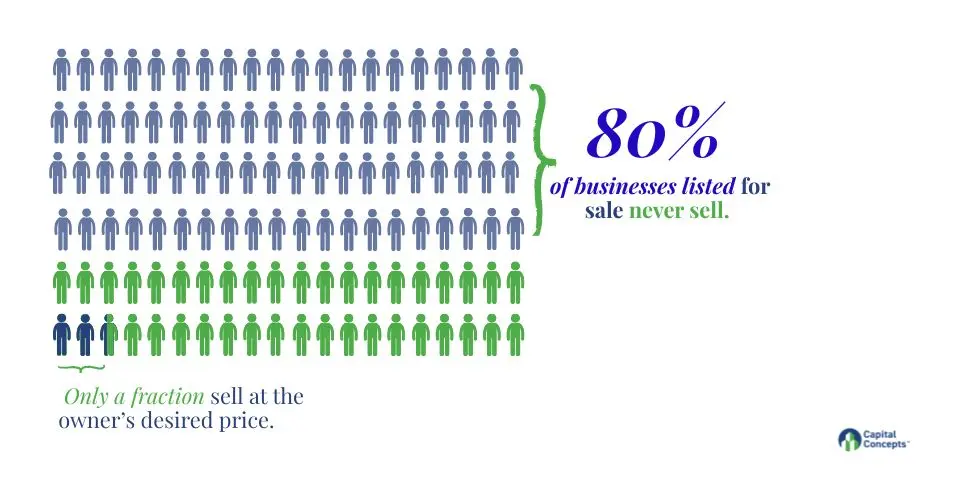
According to the Exit Planning Institute, approximately 80% of businesses listed for sale never actually sell. Of the 20% that do transact, only a small percentage achieve the owner’s desired valuation.
Those statistics are sobering.
The issue is rarely effort. Most owners work incredibly hard. The issue is preparation. Owners wait until there is an offer on the table before thinking seriously about readiness. By then, the leverage is gone.
Selling a business often takes close to a year. Many transactions include earnouts that keep the owner involved for two to three additional years. And before that process even begins, industry research suggests it takes three to five years to fully optimize a company for transfer.
If you start when you “feel ready,” you are already behind.
Source: Exit Planning Institute – State of Owner Readiness Report; EPI educational materials.
Exit Planning Is Operational Discipline
When we engage with a client, we are not asking, “Who is your buyer?”
We begin with foundational questions:
-
- What is the business truly worth today?
- Where are the operational weaknesses?
- How does performance compare to best-in-class operators in your industry?
- What would the valuation look like if those gaps were addressed?
Many owners do not have a clear answer to the first question. If they do, it is often based on anecdotal multiples or informal conversations. That is not the same as understanding how a market buyer will evaluate the company under scrutiny.
Preparation changes that conversation.
What Happens When You Wait
Delay has consequences.
Owner dependency increases.
Operational deficiencies compound quietly.
Documentation remains incomplete.
Financial reporting lacks the depth a buyer expects.
During due diligence, buyers examine every contract, process, financial statement, and risk exposure. That process is invasive by design. If weaknesses surface late, they typically translate into last-minute discounts.
The Exit Planning Institute’s research consistently shows that businesses prepared in advance command stronger outcomes than those forced into reactive transactions.
Readiness preserves leverage.
This Applies to Smaller and Larger Companies Alike
We work with companies ranging from $1 million in annual revenue up to $90 million.
Below $1 million, many businesses function more like a job. Above that threshold, the opportunity to scale becomes real.
For companies between $1–$5 million, the focus is building systems and eliminating owner bottlenecks so the company can grow beyond the founder.
For companies between $5–$90 million, the focus expands to optimization, risk mitigation, and valuation enhancement with an eye toward eventual transition.
The principles are identical.
You build:
-
-
- Leaders who can make decisions without you
- Processes that operate consistently
- Financial reporting that supports informed decisions
- A company that performs independently of personality
-
Whether you sell or continue growing, those characteristics create a stronger enterprise.
Control Is the Real Outcome
Exit planning does not obligate you to sell. It positions you so that if you choose to sell, or if circumstances require it, you are prepared.
The Exit Planning Institute’s State of Owner Readiness Report also highlights that many transitions are involuntary. Health events, partnership disputes, distress, or external shocks can force a transaction earlier than anticipated.
Owners who prepare early protect themselves against those risks.
As Stephen Covey famously said, “Begin with the end in mind.” The ideal time to start was the day you opened your doors. The next best time is today.
Bottom Line
Exit planning is not a retirement exercise. It is a value-building discipline.
It reduces risk.
It increases optionality.
It strengthens operational performance.
It preserves leverage in a future transaction.
Most importantly, it gives you control.
And control — not selling — is the real objective.
Sources
- Exit Planning Institute – State of Owner Readiness Report
- Exit Planning Institute – Educational Materials on Value Acceleration Methodology™
- Exit Planning Institute – Industry data on business sale outcomes
Related Post

Tariffs Are Squeezing Margins. Here’s What That Does to Your Business Value.
Tariffs and material cost volatility are not just a margins problem for construction owners. They are a valuation problem. Here is what rising input costs are doing to business value — and what to do about it before someone else forces the conversation.

You’ve Built Something Valuable, But Can You Prove It?
Most owners have a strong sense of what their business is worth. Lenders, investors, and buyers are looking at something different entirely. The gap between those two numbers is more common, and more costly, than most owners realize.

The Owner Dependency Trap: Why Construction Businesses Stall
Tariffs, labor shortages, boom-bust cycles — construction owners are managing more uncertainty than ever. The ones who get hurt most are the ones whose businesses can’t function without them. Here’s why that matters now.
0 Comments